|
|
| Mustang, Texas |
|
|
| Mustang, Texas |
|
|
|
|
During the 1940s and early 1950s, you could drive the dusty roads of Mustang Community and read the names of Tergerson, Rogstad, Hanson, Nygaard, Hastings, and Knudson. As you continued your drive, you might see other names such as Johnson, Hansen, Moore, Carlson, Jermstad, and Dahl, as well as others. For the most part, these families were descendants from Norwegian immigrants who came to America as early as the 1840s. Most of the early immigrants came to Bosque County via Illinois, New Orleans, and East Texas. Many families landed in Chicago, moved west and established settlements in Illinois; while others settled in Minnesota and other regions. In 1976, Jan and I passed through a small town called Norway, Illinois. Trying to find some Norwegian families, I looked for names on mailboxes. It seemed apparent that most of the Norwegians had either moved away or died. I soon found the Cleng Pearson Memorial Park. Nearby was a cemetery that told me that this town was once most certainly home for many Norwegians, for on the headstones were the same names you would find on the headstones at the Rock Church or Norse Cemeteries in Bosque County. Cleng Pearson led many families from Illinois to East Texas communities such as Brownsboro, Normandy, and Four Mile Prairie. A few years later, Pearson discovered Bosque County. Since there was an abundance of land, he went back to East Texas and brought several families to Bosque County where the rolling hills and plenty of fresh water made the Norwegians feel a little closer to the Mother land. These valleys and hills reminded them more of Norway than the flat plains in East Texas. The Norse Community became the stronghold for early Norwegians in this area. It continued to be home for the descendants of Norwegian immigrants for generations to come. As more and more families moved to Norse, things soon became rather crowded. The later Norwegian arrivals as well as other nationalities were forced to settle in the outlying areas. Communities such as Neils Creek, Bee Creek, Boggy, Turkey Creek, Harmony, and Mustang soon became thriving farm communities. Lars Jermstad was an early settler in Mustang. He bought land from W. R. Baker and built a log house. The house had two rooms with split log floors and rough-hewn ceiling beams. He built a small barn, a granary, and other small buildings. Jermstad's farmstead was located just a few yards from scenic Mustang Creek that provided ample fresh water. Jermstad farmed the land, raised livestock, and raised his family at this location. Mrs. Jermstad died of tuberculosis in the cabin. The cabin burned down years later.
Another family to settle early in Mustang was the Tergersons. Tellef Tergerson first settled in East Texas. He had planned to move to Bosque County, but Tellef died. His wife, Asborg, soon afterwards moved her family to Bosque County and eventually to the Mustang Community. Her sons Terry T. and William T. bought land and settled on adjoining farms. The Tergerson’s paid fifty-two cents an acre for their land. Terry T. and William T. became leaders in the community, and they worked hard to improve conditions in the community -- physically, politically, and spiritually. Ole Jermstad was another early settler in Mustang. He apparently was a very successful farmer and businessman, for he eventually was the owner of seven farms. He gave a farm to each of his children. Until recently two of these farms were still owned by Jermstad's descendants. Adelia Rogstad (Mrs. B.C. Rogstad), a daughter of Ole Jermstad, owned one of the farms until she sold the farm to Cleon Gorbett after she was too old to live alone. Tomena Wallace, daughter of Adelia, lived on one of the other Jermstad farms. The farm was sold after her death. The Harry White Cattle Company owned much of the land in Mustang Valley. In 1893, at the age of twenty-four, George Knudson came to Mustang from Norse and bought acreage from White and from the Smith Estate. George acquired an old house from Ben Ammons on Mustang Creek. He used a yoke of oxen to pull it to the site of the present-day Knudson farmhouse. George Knudson began farming and started a family. A two-story house was built onto the old house in 1905. The barn was completed in 1908. In the year 1893, Tom Hastings moved to Mustang. He brought his family to the area north of Flat Top Mountain along the east fork of Mustang Creek. This farm is still owned by the Hastings family. Tom's brother, Nery settled on the farm just to the north. This farm is still in the Hastings family. Ben Ammons was another landowner in Mustang. He owned land north of Flat Top Mountain on both sides of Mustang Creek. Three of today's farms were once part of Ammons land. Many of the original Norwegian farmsteads have been sold and re-sold many times, but there are still a few farms owned by the heirs of the early settlers. Clarence Terguson, Chester Jermstad, John Hastings, Mrs. Ray Hastings, Oliver Hanson, and Tirah Knudson Wallace still own and live on these farms at the time of this writing. It is not known for sure just how Mustang Community derived its name. Some said it was named after the delicious Mustang grapes that were once so plentiful here. Some said it was named for the wild Mustang horses that roamed the valley before it was settled. Others feel it could have been named for the meandering Mustang Creek that runs southward through the community.
They soon held a Sunday afternoon meeting at the home of Salve Knudson, and it was at that meeting they decided to build another church. Saint Olafs Kirke, the "Old Rock Church," was completed in 1886. It was constructed of native limestone rock that is so plentiful in this area. Andrew, Ole, and Christian Mickelson built it. J. K. Rystad served as pastor for both the Norse and Rock Churches until G. G. Odegard was called to be the first full time pastor of the Rock Church. Pastor Estrum was the only other full time minister to serve this church, and he did so until the new Saint Olaf Church was built at Cranfills Gap in 1917. For a number of years services alternated between the Rock Church and the Gap Church. From many vantage points throughout the Mustang Community, you can look toward the south and see the beautiful white church standing as a monument to the many Norwegians who were baptized, confirmed, married, and eventually buried there. It must have been a beautiful sound to hear the toll of the huge bell as it sounded the call to worship. A stroll through the cemetery brings back many fond memories of people I knew as a young boy and as an adult. As I read their names on the markers, I remember something special about each one. The old cemetery (where four generations of Knudsons are buried) reminds me of my Norwegian heritage. Several years ago Grandpa and I were doing some small jobs at the Rock Church. After we finished, we took time out to look around. We went inside and sat down in a pew, and he began to reminisce. He told me a story I shall never forget: I remember a particular incident that happened here during church services back when I was just a little boy (maybe seven or eight years old). In those days during the service the men would sit on the right side of the church (as you came in) and the women folks would sit on the left. Of course, in those days (circa 1900), we didn't have electricity or air conditioning, but we did have these large windows. When the windows were raised all the way up to the top it provided pretty good “natural” air conditioning. There was almost always a good breeze coming from the south, and as a rule it was pretty comfortable most of the time. On a particular day I remember sitting with my Pa (George) right behind Grandpa Hanson. Grandpa always sat up very straight and always had his shoulders drawn back. I always felt he sat that way because he was a military man during the Civil War. On that particular day, I remember just sitting there as the preacher began his sermon. The preacher's sermons usually didn't interest a young boy like myself, so, like most kids, I had to amuse myself some way. Many times I would find good entertainment just watching the dirt daubers fly around, and occasionally it would really get exciting when one would land on someone who was just about to doze off. Boy! Would that wake 'em up! Sometimes I'd really have to fight it to keep from laughing out loud. As I said, Pa and I were sitting right behind Grandpa, and he had a pretty good bald spot on the top of his head. He attempted to cover his bald by combing what hair he had over it. His hair was white, long, and very thin. He was really having hair problems. There was a good breeze blowing through the congregation that day. During one of the gusts of wind, his hair was blown from the top of his head until it stood straight out to the opposite side. His hair was so thin it reminded me of white feathers waving in the breeze. He would take his hand and carefully place the long strands of hair back into place, and he would no sooner get things fixed just right when another gust would expose his bald spot again. I remember how patient he was, for I'm sure this happened a dozen or more times, and each time he would carefully recover his bald spot. I really did get a kick out of that. Things like that really seemed to make the sermons seem shorter. That same day Grandpa and I went behind the church altar to take a look around. I spotted a small hole in the back of the altar, and you could peek through and see out into the church. Grandpa said that the hole was probably used many times by the preacher to peek out to see who all was in church before he started the service. There was a small polished metal mirror hanging on the wall behind the altar, and from the looks of it had been there many years. Grandpa said this is the mirror the pastor probably used to put on his "somber face" before going out into the church. I remember him saying, "I wonder why the preacher had to have such a somber expression on his face during church? I can't remember a single time when the preacher would laugh or smile or say anything humorous during the church service. I never could understand why things had to be so dry and somber."
During the years that Mustang school was in existence, there were many teachers who taught there. Of course, the pay was meager and the teaching conditions were not always good. During the summer, school was dismissed, and Norwegian parochial school was held in the building. The days were hot and long. In the winter, the teacher and students oftentimes had to wear their coats inside the building, and they tried to keep the old wood stove as hot as possible. In spite of their attempts to keep warm, I'm sure there were some days that the bitter cold hindered their education. However, kids were more used to uncomfortable conditions and probably adapted much better than kids would today. The teachers not only served as teacher, but they, in most cases, had to be the principal, coach, and counselor to all students, grades 1 through 11. The enrollment at times was rather large for the facilities. The older kids often times helped the teacher with the smaller kids. Teachers faced many of the same problems that teachers face today -- truancy, disinterest in school, learning disabilities, etc. --- but the teachers did have one thing going for them...support and respect from the parents, and even more respect from the students. The authority of the teacher was never questioned. The teacher was also called upon for advice by many of the adults in the community. The teacher, as well as the preacher, were probably the most respected people in the community. Education was a luxury as far as most adults were concerned, and they wanted to have as much quality education as they could find and afford for their children. Most people in the community had no formal education. If they had an eighth grade education, they considered themselves very lucky. The kids, for the most part, walked to school. Most lived within a mile or so radius of the school, but some had a longer daily journey to and from school. Some rode horseback. On rainy or extremely bad days the kids were sometimes taken to school in a buggy or hack. During certain times of the year the older children in the family had to miss school in order to help with chores at home. They sometimes were needed at home to help with butchering; chopping wood; taking care of a new baby; and, of course, helping out with the harvest or picking cotton. Public school would usually begin after cotton picking (late September) and turn out in time for the grain harvest (June). Most children would attend Norwegian parochial during the summer. Parochial school was conducted in the Norwegian language. The curriculum consisted of study in Luther's Small Catechism, Explanation and Bible History. Only on special occasions was English used (usually requested). Hymns were memorized and Norwegian writing was also taught. The parochial school pretty much fell by the wayside sometime during the 1930s. The old parochial school became what we today call Confirmation classes and Vacation Bible School. Most of the Norwegian communities conducted a parochial school. Such schools were also conducted at Turkey Creek, Harmony, Shell Rock, Meridian Creek, Bee Hill, as well as in other communities. Classes usually began at 9:00 A.M. and continued until 4:00 P.M. for five days a week. The term lasted from four to eight weeks. The school term would often change according to harvest time. The first parochial school was the Peck School in Norse. Sessions were conducted there as early as 1866. Information concerning enrollment is a bit sketchy, but old school records and courthouse records reveal some interesting facts about the Mustang School District. I heard that the Mustang Community usually had a good baseball team. Everyone who played ball in this area during the 1930s will say that "Red" Tergerson was really a good pitcher. Andrew Grimland of Cranfills Gap introduced baseball to Bosque County. Andrew Grimland had a very good curve ball. In fact, it was good enough to earn him a job pitching for the old Ft. Worth Cats professional baseball team. All communities had teams and local heroes, and they took their competition with other communities very seriously. Many "hot games" have taken place at Harmony, Norse, Neils Creek, and Mustang. There were many fun events that took place at Mustang School. They had "box lunch" dinners, musicals, and plays. My mother said she used to really enjoy the plays put on at the schoolhouse by students and members of the community. She said Check Jermstad always played the handsome, young hero since he was so handsome. Her dad (O. C. Knudson) would play a preacher or some part like that. Many others also participated in different roles. They also had picnics at the school. After eating, there would always be games for everyone to play. Probably the biggest event of the season was the Christmas program at the school. There was caroling, feasting, and the ever-so-popular Christmas play. It was very easy to get into the "spirit" of Christmas after attending or participating in this memorable event. The old days at Mustang School have fond memories for many people. The school building is still standing on the same site. Milford Carlson's heirs now own the land and use the building for storage. In 1938, Mustang School was closed after it consolidated with the school at Cranfills Gap. I'm well aware that consolidation had its good points, but I personally feel that consolidation robbed the community of much of its personality and pride, which is so important to hold the community together. Interest in the educational process had to diminish when their kids were bussed to a school several miles away. I'm not saying the parents no longer cared, but since the kids were being educated out of the community, many parents simply let the "system" run the school. The teacher in the rural community school was a vital part of the community. The teacher knew each student very well. The teacher knew the ability and the needs of each one, the problems that might have been going on in the home, or anything else about the child that might affect his or her education. The teachers in Mustang were boarded at the home of Terry Tergerson. In later years, Coin Tergerson provided room and board for the teachers. Mustang usually had two teachers. Since the teachers lived in the community, they always knew what was going on in the lives of the people of the community. If there was a tragedy, illness, or something else in the community the teacher was always sensitive to the fact and knew how to help when the need arose. Teachers of that era were, for the most part, very strict disciplinarians. Students wouldn't think about being disrespectful to the teacher. I'm sure there were many interesting and good teachers who taught at Mustang over the years. Most teachers taught only one or two years. Some of the earlier teachers had very little training while others were highly qualified. Mustang had two teachers during its peek enrollment years. Sometimes the teachers were very young, and the students in the upper grades were very near the age of the teacher. Teachers during these days had to teach all subjects, and for the most part they probably did an excellent job. Life in the Mustang community was different from the hustle and bustle of today. All families were pretty much on the same economic standard, for all were farmers, and they made their living by hard work and the sweat of their brows. Each family had a milk cow and raised chickens or turkeys, cattle, and hogs. Of course, they slaughtered and butchered their own beef and hogs. Their fields produced oats, wheat, barley, milo, and corn for their own consumption and feed for their livestock. Most farmers raised sheep and goats. Up until the 1940s, most farmers raised cotton for a "cash crop." What little money the farmer would make during the year would generally come from his cotton crop. In the early days (1860s-1930s), farmers used oxen, horses, and mules to work their land. The work was hard, slow, and tedious. It would take several days just to plow a few acres. On hot days the farmer would have to plow an hour or so, and then rest his team in the shade of a live oak tree, or anywhere he could. This made plowing very slow, but these "breaks" were very necessary for the animals. Grandpa told me it was very important to take good care of your team if you wanted to get the most out of them. Farming was a very lonely job. The farmer would spend most of the daylight hours in the field without seeing another person except maybe his family at noontime. After a short dinner break he would be right back in the field, doing what he would probably be doing for the rest of his life...plowing the ground that would provide a living for him and his family. A farmer had a certain amount of ground to cover and only a certain amount of time to do it. So, he had to keep his "nose to the grindstone." It seems modern farmers would have more time on their hands than the farmers of the bygone days. Before tractors, farmers were seemingly better stewards of their time than farmers today. I remember an old bachelor named Emil Peterson who had a place east of the Gap. As late as 1948 or 1949, he was still farming with a team of horses. One day Grandpa and I were going to the Gap, and we went by a field where Emil was plowing. He was riding a turning plow pulled by two horses. As we passed by, I remember Grandpa saying, "I wonder what ol' Emil is thinking about right now? I've sat on a plow or cultivator pulled by Pete and Jack (his mules) many times and just thought and day dreamed all day long. A man can really do a lot of thinking when he's out there all by himself like that." A farmer didn't have all the herbicides and pesticides he has today. If insects invaded his crops, the farmer was helpless to do battle with them. The only weapon he had to combat weeds was his cultivator and hoe. Many days of hot, hard work, toil, and sweat went into putting in a crop. If God gave him rain at the proper time, he would more than likely make a "bumper crop." If the rains did not come, all his labor was usually for nothing. Farming is probably one of the best things I know of to keep a man in close contact with God. Living off the land is a natural thing to do, and many men get a great deal of satisfaction from it. The men of Mustang have always been willing to help a neighbor during hard times or during an emergency. I remember one time in particular when Coin Tergerson had a heart attack and he had an oat crop in the field ready for harvesting. A couple of days later men in the community arrived with their combines and harvested his entire crop in less than a days time. In a few days they returned with their tractors and plows and plowed under the stubble. This is just one of many times men united to help out a neighbor farmer.
Another rock house stands east of Mustang Creek about a mile west-southwest of the Terry Tergerson house ruins. This house was probably built by the Sormrude family about the same time that Terry Tergerson built his house. This house is still being lived in today by the Bill Coons family. This old house had additions on at least two different occasions. There stands an old rock chimney up in Spencer Hollow. It is all that remains of a house that once belonged to a family named Taylor. That family lived there probably before the Norwegians settled in the community. According to Grandpa, the house was a wood structure that either was torn down or rotted away years ago. Since that time the area has been bulldozed, and the only thing still standing is the chimney. Grandma (Sadie) said an old bachelor named Tresko Nelson lived up in Spencer Hollow at one time (maybe in this old house), and the old man some way made it known that he would like to have some chicken and dumplings. Grandma said she made him some, and Grandpa George took it up to him. Grandma said his name, Tresko, meant "wooden shoes" in Norwegian.
When Conrad got here, he hooked chains to the foundation and then hooked the team up to it. The team pulled and pulled but couldn't budge it. Conrad and I took shovels and dug out all around it and pried it up the best we could and put rocks under it so it wouldn't settle back down into its ruts. We got it ready to move and Conrad yelled “git up” and the mules pulled and strained and finally got it to moving. Once it moved, ol' Pete and Jack pulled it to the spot where it is today. The mules farted ever’ step of the way. That was really a heavy load. Conrad really did have some good mules. JMW/March 1980 |
|
|
|
|
|
|
|

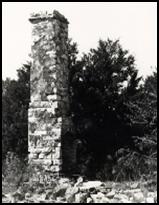 Ole
Andreas Olson emigrated from Norway in 1872. He settled in the Mustang
area in April 1877. He built a log house and established his farm. The
original log house has fallen down, but the rock chimney still remains.
Another house was built in 1881. Carrol Nelson, a great nephew of Olson,
lived on the farm until his death.
Ole
Andreas Olson emigrated from Norway in 1872. He settled in the Mustang
area in April 1877. He built a log house and established his farm. The
original log house has fallen down, but the rock chimney still remains.
Another house was built in 1881. Carrol Nelson, a great nephew of Olson,
lived on the farm until his death.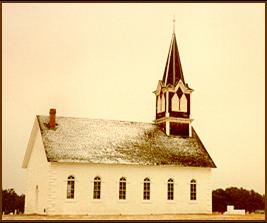 During
the early days, social activities centered around the school or church.
Families rode in buggies or rode horseback to church services. For many
families it was a long and hard journey to the Norse Lutheran Church. As
more and more families settled farther from the heart of the Norse
community, some began talking about building another church that would
serve families living closer to Meridian Creek.
During
the early days, social activities centered around the school or church.
Families rode in buggies or rode horseback to church services. For many
families it was a long and hard journey to the Norse Lutheran Church. As
more and more families settled farther from the heart of the Norse
community, some began talking about building another church that would
serve families living closer to Meridian Creek. 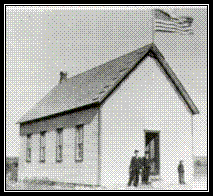 Another
institution of great importance to the community was its schoolhouse. All
rural communities took much pride in their schools. Like the church, much
activity centered around the school. Most rural schools of the day were
typical of the Mustang school district.
Another
institution of great importance to the community was its schoolhouse. All
rural communities took much pride in their schools. Like the church, much
activity centered around the school. Most rural schools of the day were
typical of the Mustang school district.
 The
Mustang community school was probably very typical of most schools in
Bosque County. There were two different buildings built on the site. The
first school was built in March 1888. The original building was a one room
wood structure. It served its purpose until it was torn down and a larger
one built in its place. The second building was made of masonry. It was
very well built and served the community for many years. Terry Tergerson
acquired the land on which the building still stands today. The land was
purchased from the Camfield and Dunlap families. The Camfields lived just
below the school across the branch called "Camfield Branch." There were
many children who attended school at Mustang. I'm sure alumni of this
rural school could recall many interesting stories, including humorous
stories and some stories they would probably like to forget. You must
remember the last years of the school's existence were very "hard times,"
depression years. Even though the country was suffering through the
depression, the people living in rural farming areas were not as hard off
as the city dwellers. These people were farmers, and they grew ninety-five
percent of their food. They had no money, but they had plenty to eat.
Their clothes might have been a little bit ragged, but they did have
adequate food, clean clothing, and shelter. It was times like those that
could pull people closer together. In those days life was much slower
paced, and everyone experienced the same hardships and problems, so they
knew how to minister to their neighbors.
The
Mustang community school was probably very typical of most schools in
Bosque County. There were two different buildings built on the site. The
first school was built in March 1888. The original building was a one room
wood structure. It served its purpose until it was torn down and a larger
one built in its place. The second building was made of masonry. It was
very well built and served the community for many years. Terry Tergerson
acquired the land on which the building still stands today. The land was
purchased from the Camfield and Dunlap families. The Camfields lived just
below the school across the branch called "Camfield Branch." There were
many children who attended school at Mustang. I'm sure alumni of this
rural school could recall many interesting stories, including humorous
stories and some stories they would probably like to forget. You must
remember the last years of the school's existence were very "hard times,"
depression years. Even though the country was suffering through the
depression, the people living in rural farming areas were not as hard off
as the city dwellers. These people were farmers, and they grew ninety-five
percent of their food. They had no money, but they had plenty to eat.
Their clothes might have been a little bit ragged, but they did have
adequate food, clean clothing, and shelter. It was times like those that
could pull people closer together. In those days life was much slower
paced, and everyone experienced the same hardships and problems, so they
knew how to minister to their neighbors.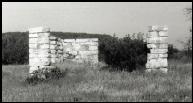 There
are still several old ruins standing in the Mustang community. Terry
Tergerson built a rock house soon after he settled in Mustang. The house
burned in the 1940s, but its walls are still standing near the old water
tank. The old rock house ruins, I hope, will continue to stand as a
monument to the Tergerson family in Mustang for years to come.
There
are still several old ruins standing in the Mustang community. Terry
Tergerson built a rock house soon after he settled in Mustang. The house
burned in the 1940s, but its walls are still standing near the old water
tank. The old rock house ruins, I hope, will continue to stand as a
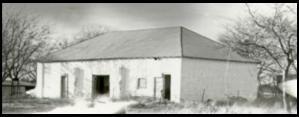
monument to the Tergerson family in Mustang for years to come.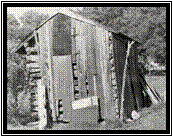 One
of the oldest Norwegian structures in Mustang is the old granary still
standing on Molden Knudson's place (the old Lars Jermstad place).
Probably, this is one of three or four buildings constructed by Lars
Jermstad when he first settled here. The granary originally was located
near the creek and later in the highway right-of-way of Hwy 22. In 1931,
after Molden Knudson bought the place, he wanted to move the granary from
the highway right-of-way. He asked his brother Conrad to bring his mules
(Pete and Jack) to help him move it. In an interview, Uncle Molden said:
One
of the oldest Norwegian structures in Mustang is the old granary still
standing on Molden Knudson's place (the old Lars Jermstad place).
Probably, this is one of three or four buildings constructed by Lars
Jermstad when he first settled here. The granary originally was located
near the creek and later in the highway right-of-way of Hwy 22. In 1931,
after Molden Knudson bought the place, he wanted to move the granary from
the highway right-of-way. He asked his brother Conrad to bring his mules
(Pete and Jack) to help him move it. In an interview, Uncle Molden said: